



October Chinese Stroller Market: New Opportunities amid Challenges


Recently, the China Toy and Juvenile Association (CTJPA) released the "China Strollers Export Report for October 2025", which pointed out that in October, the export of Chinese strollers (HS Code 87150000) presented a distinct feature of " Under overall pressure, with structural optimization". Despite a year-on-year decline of 15.6% in export value to 120 million US dollars in October and a cumulative export value of 1.32 billion US dollars from January to October, which also dropped by 13.5% year-on-year, the growth highlights in specific market segments and the differentiated performance of regional exports have pointed out a new direction for the industry's development.
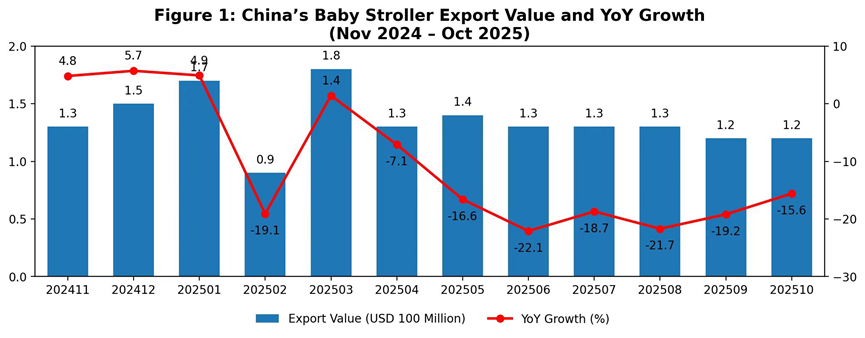
1.Market differentiation is significant: Emerging markets become the growth engine.
The most prominent feature of this month's data is the structural disparity in export destinations. Among the top 10 export destinations, market performance shows a "two extremes" situation: core markets represented by the United States have grown steadily, emerging markets like Brazil have seen explosive growth, while traditional markets such as the European Union and Southeast Asia have declined significantly.
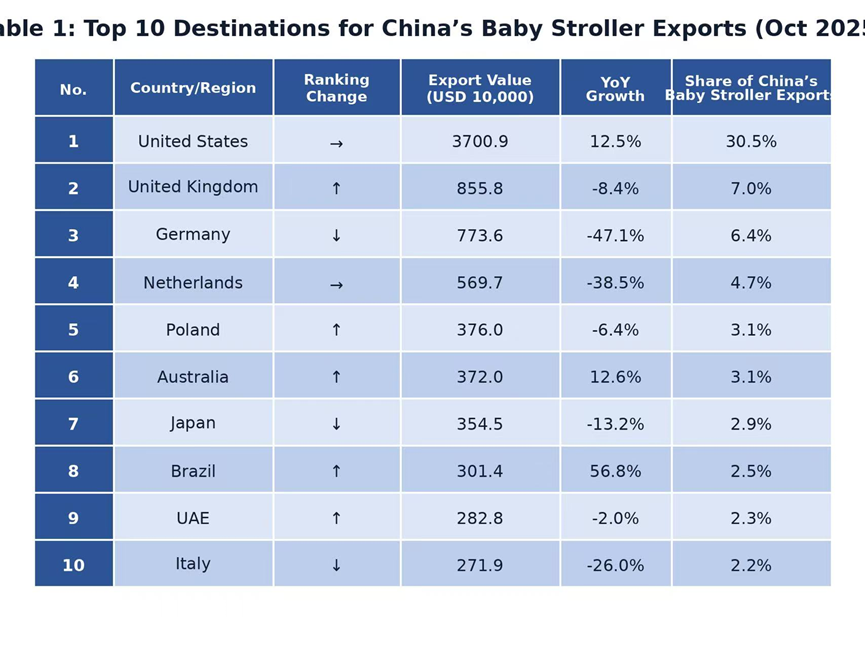
The United States, as the largest export destination for Chinese baby strollers, contributed an export value of 37.009 million US dollars in October, representing a year-on-year increase of 12.5%. It accounted for 30.5% of the total export value, up by 7.6 percentage points compared with the same period last year, further consolidating its core position.
It is worth noting that the growth momentum in emerging markets is particularly strong. Brazil, with a year-on-year increase of 56.8%, stands out as the top-performing market among the top 10, with an export value of 3.014 million US dollars. This growth is not an isolated case. The overall Latin American market has performed well, with an export value of 11.186 million US dollars in October, a year-on-year increase of 6.6%. Among them, Brazil accounts for 26.9% of the region's export value and contributes 157.7% to the regional growth. Colombia, with a growth rate of 93.1%, has become another growth pole in the region.
In sharp contrast to the emerging markets, the EU and Southeast Asian markets witnessed a significant decline. The export value to the EU was 26.589 million US dollars, a year-on-year decrease of 37.0%, and its share of the total export value dropped by 7.4 percentage points compared with the same period of the previous year. Among them, Germany, as the largest export country within the EU, had an export value of 7.736 million US dollars, with a year-on-year decline of 47.1%. The export value to Southeast Asia was 5.983 million US dollars, a year-on-year decrease of 25.3%. Although Indonesia maintained the leading position with a regional share of 29.6%, it still failed to reverse the overall downward trend.
2.Performance in the RCEP region is diverging, with Australia emerging as a key growth driver.
As an important platform for regional economic cooperation, the overall performance of the RCEP member countries' market has fallen short of expectations. In October, China's exports to these countries amounted to 147.78 million US dollars, a year-on-year decrease of 17.7%, accounting for 12.2% of the total exports, a slight drop of 0.3 percentage points compared with the same period last year.
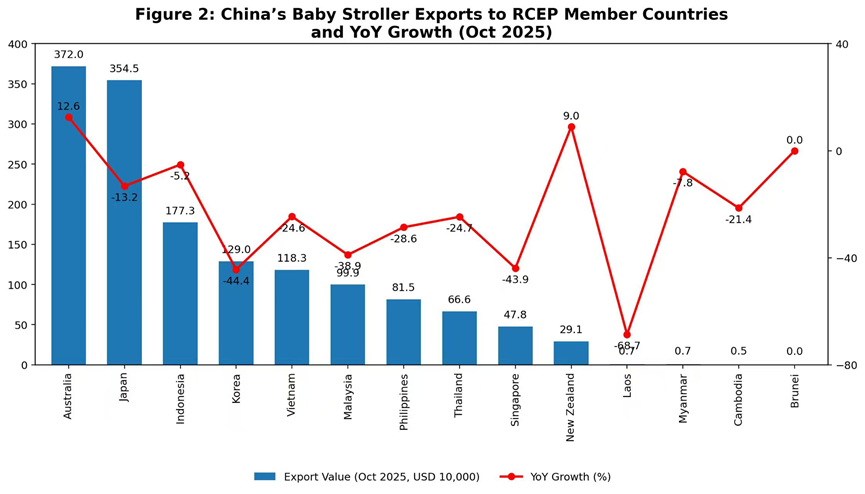
However, there are still bright spots in the segmented markets. Australia, with an export value of 3.72 million US dollars and a year-on-year growth of 12.6%, has become the largest growth engine within the RCEP region. It accounts for 25.2% of the total export value in the RCEP region, demonstrating strong market demand despite the overall decline in the region. In contrast, markets in Southeast Asian member countries such as Indonesia and Vietnam have shown varying degrees of decline, reflecting the unevenness of market demand within the RCEP region.
3.The regional export pattern remains stable, with Hubei emerging as a new benchmark for growth.
The domestic export regional pattern shows the feature of "stable leading regions and rising middle regions". As a traditional export powerhouse, Guangdong Province's export volume in October was 433.98 million US dollars, accounting for 35.7% of the total export volume. Although it decreased by 6.8% year-on-year, its proportion increased by 3.4 percentage points compared with the same period last year, maintaining its leading position firmly. Zhejiang Province and Jiangsu Province ranked second and third with 20.6% and 14.5% of the total export volume respectively, but both showed varying degrees of decline.
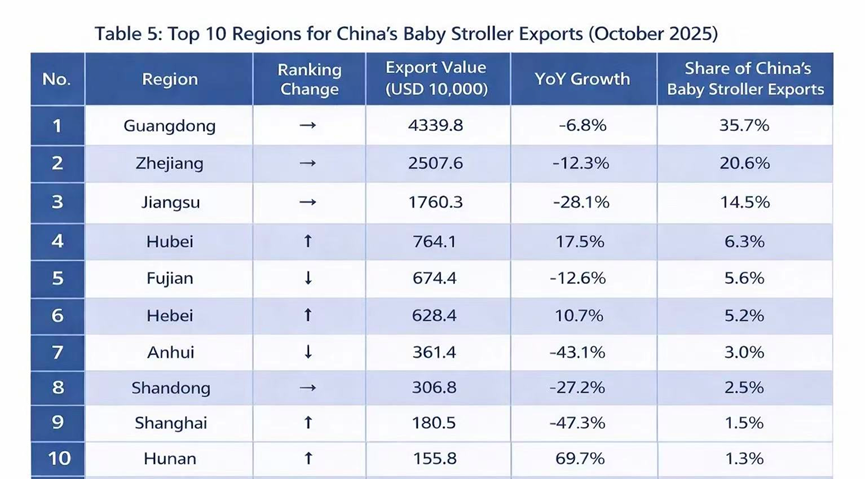
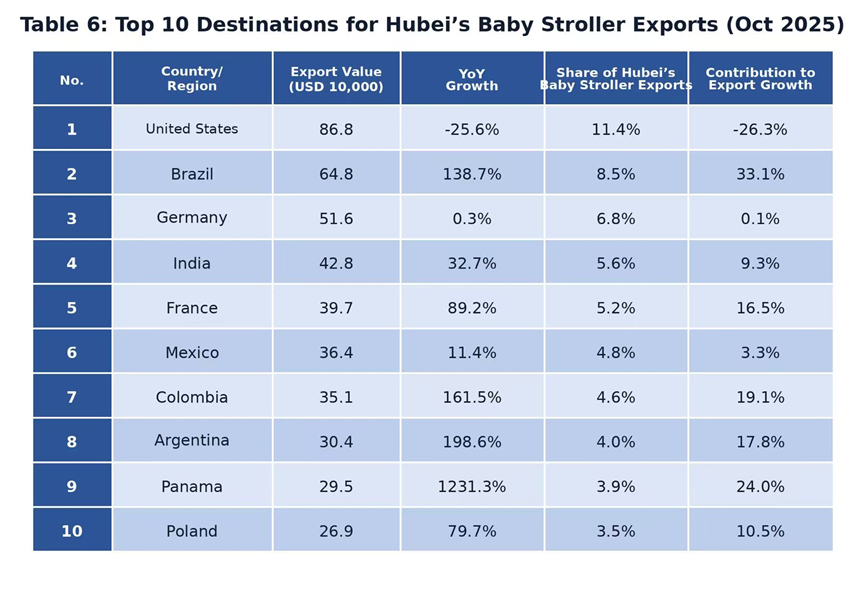
The Central China region stood out particularly, with Hubei Province leading the way in terms of export growth that month. Its export value reached 7.641 million US dollars, a year-on-year increase of 17.5%, accounting for 6.3% of the total export value, up by 1.8 percentage points compared to the same period last year. The growth was mainly driven by emerging markets. Exports to Brazil amounted to 648,000 US dollars, a year-on-year increase of 138.7%, contributing 33.1% to the growth in Hubei's exports. Latin American countries such as Colombia and Argentina also contributed significantly to the increase. Additionally, Hunan Province saw the fastest export growth rate at 69.7%, demonstrating the rising potential of central provinces in the export of baby strollers.
4.Challenges and opportunities coexist; deepening engagement in emerging markets is the key to breaking the impasse.
Overall, in October 2025, the Chinese baby stroller export market faced the challenge of a decline in traditional markets such as the European Union and Southeast Asia. However, it also found new growth space in emerging markets such as Latin America and Australia. In terms of trade methods, the stable performance of processing trade provided a buffer for the industry, while the breakthrough of general trade in emerging markets indicated long-term growth potential. At the domestic regional level, the rise of central provinces injected new vitality into the export market.
In light of the current export characteristics, enterprises can precisely focus on two aspects: first, to deeply cultivate the emerging markets in Latin America, especially Brazil and Colombia, where demand is strong, by increasing investment in channel building and local services to fully leverage the growth dividends of 93.1% and 56.8%; second, to optimize the trade structure, maintaining stability through processing trade (which only decreased by 2.8% year-on-year), while enhancing the added value of general trade products and focusing on tapping into potential markets such as Australia under the RCEP. Against the backdrop of differentiated global demand, only by anchoring on growth highlights and strengthening structural advantages can continuous breakthroughs be achieved in the export market.
Recommended News

CSI-Certified Morning Crafts Drives Innovation in Pop-Culture Stress-Relief Toys and Cultural Gifts
2026-08-20

CSI-Certified Taikang Expands High-Volume Squeeze & Squishy Toy Manufacturing for Global Buyers
2026-08-24
Average Price Up 6.1%, Sales Revenue Defies the Trend! June Baby Crib Market Moves Beyond Low-Price Competition
2026-07-30
CSI-Certified Lanxi Bozhong Unveils Trendy PU Squishy & Stress-Relief Novelties for Global Buyers
2026-08-23