



UK Toy Market Sales Up 12% in 2026 — What's Driving the Growth?


The United Kingdom is Europe's second-largest toy market, trailing only Germany. According to Circana data, UK toy sales grew 6% in full-year 2025, reaching £3.9 billion. A mature retail ecosystem, robust consumer spending, and high receptiveness to licensed and innovative toys have provided sustained momentum for market growth. Entering 2026, that momentum has not cooled — sales rose 8% year-on-year in the first four months, while volume surged 12%, with the pace of growth accelerating further. This article breaks down which categories and themes are leading the charge.
1 Building Sets Stand Out as the Clear Leader
From a category perspective, the market presents a picture of one standout performer alongside broad-based strength across multiple segments. According to Circana data, Standard Building Sets is both the largest and fastest-growing category by value so far this year; Traditional Plush ranks second in incremental growth, signaling the return of emotional companionship-driven consumption; and Miscellaneous Toys takes third place, propelled by trending items that reflect current consumer hotspots.
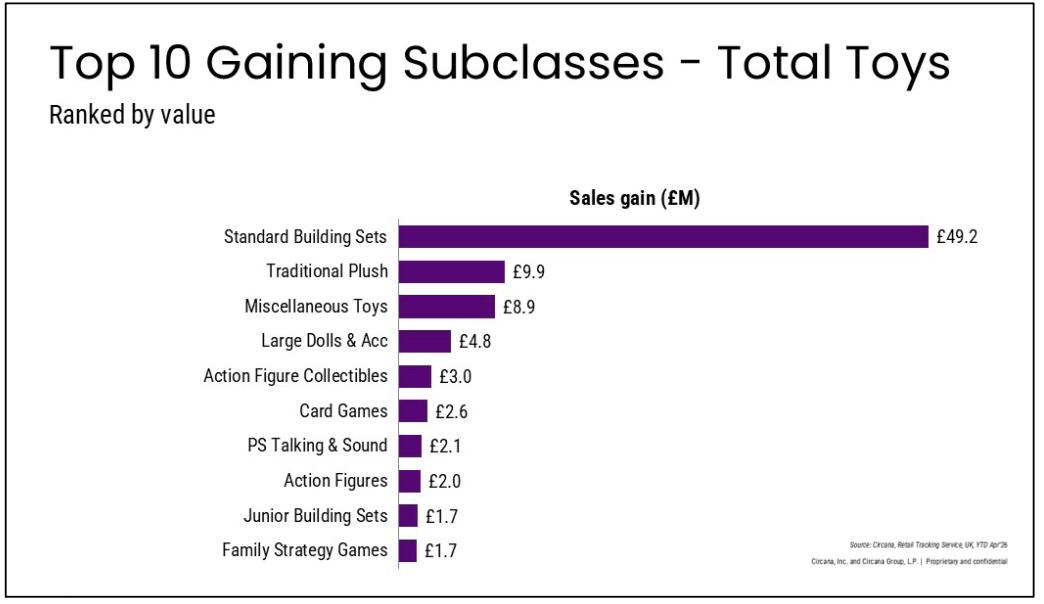
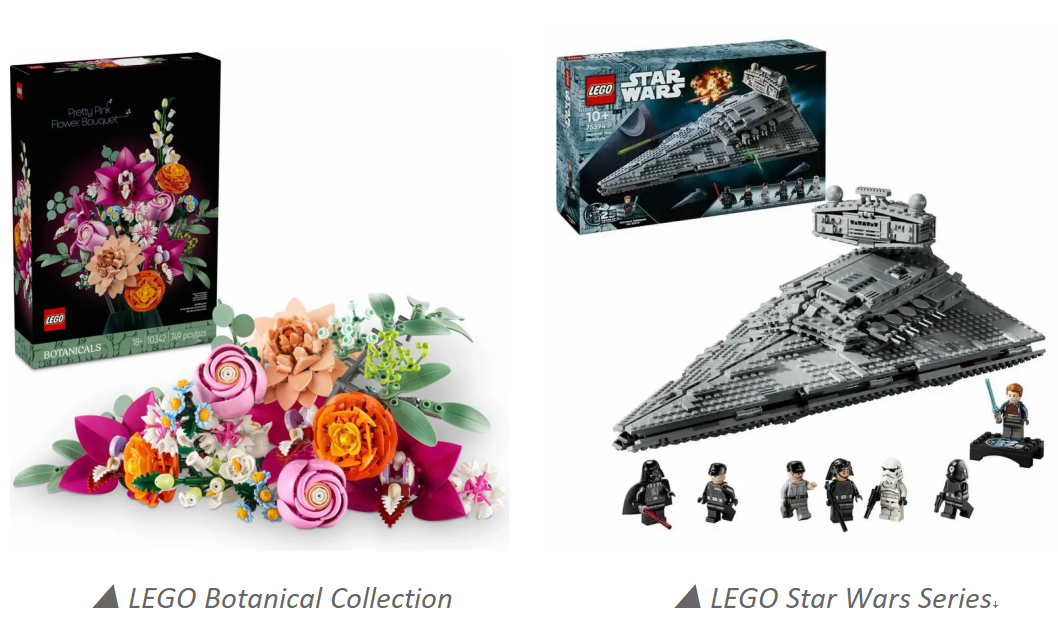
In the January–April period, Standard Building Sets led the UK toy market in sales value, accounting for 22% of total market revenue. It was also the fastest-growing category, delivering an incremental sales gain of £50 million — five times that of the second-place category. Multiple growth drivers underpin this performance: licensed products have held steady, while adult-fan-targeted lines such as LEGO Botanical and LEGO Star Wars have also contributed significantly.
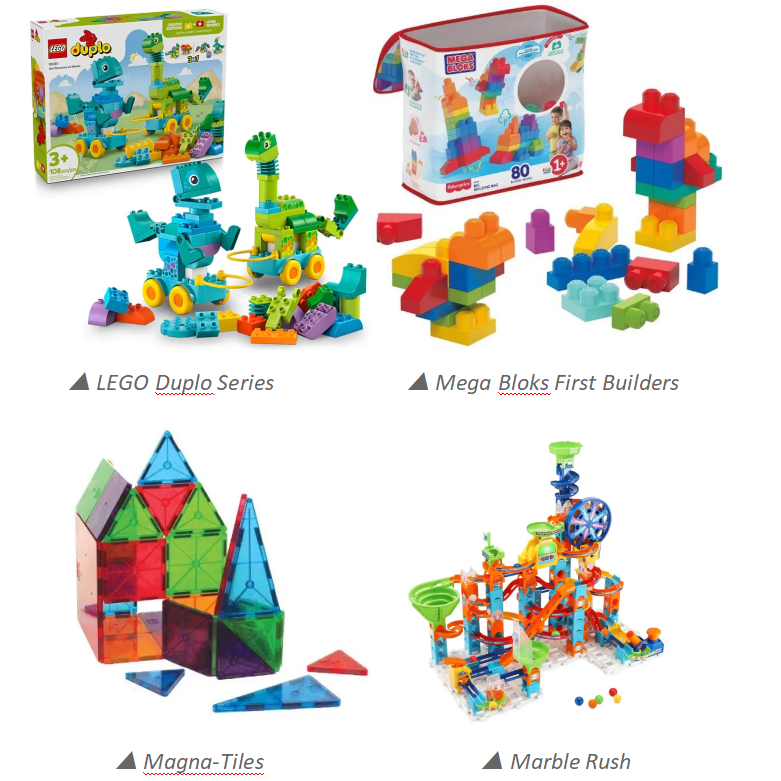
Beyond Standard Building Sets, the Junior Building Sets category is also worth noting. It ranked ninth in growth, driven jointly by brands including LEGO Duplo, Mega Bloks First Builders, Magna-Tiles, and Marble Rush. This demonstrates that building-set growth is not confined to a single segment — it spans from adult enthusiasts to young children, forming full age-range market coverage.
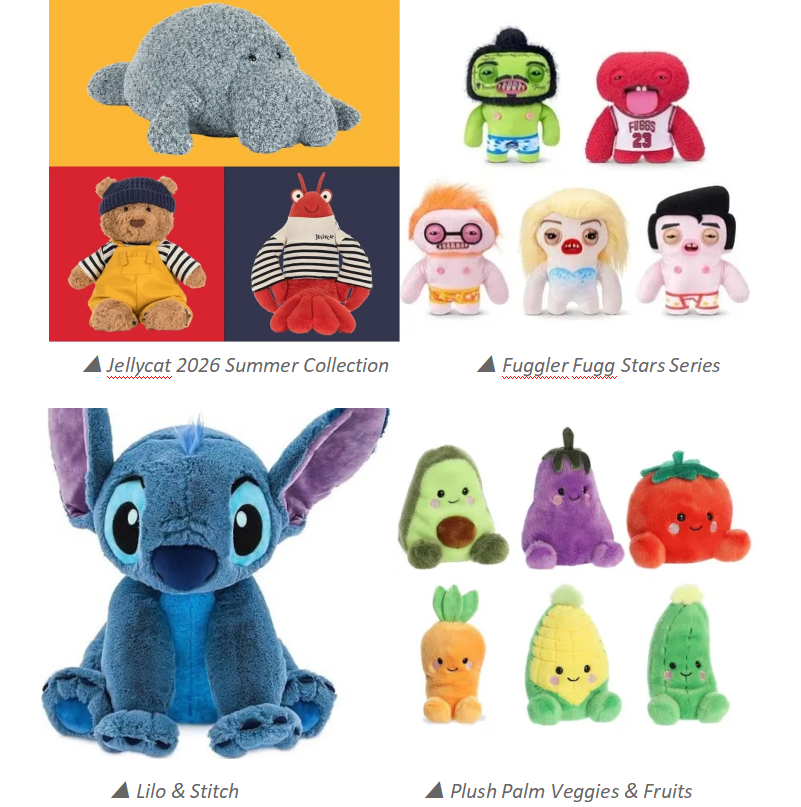
Traditional Plush is the second-fastest-growing category in 2026, adding nearly £10 million year-to-date. It represents the resurgence of emotionally driven companion purchases. Jellycat leads the category with close to £5 million in incremental sales, placing it fifth among all toy brands overall. Fuggler, Lilo & Stitch, and Palm Pals have also posted gains.
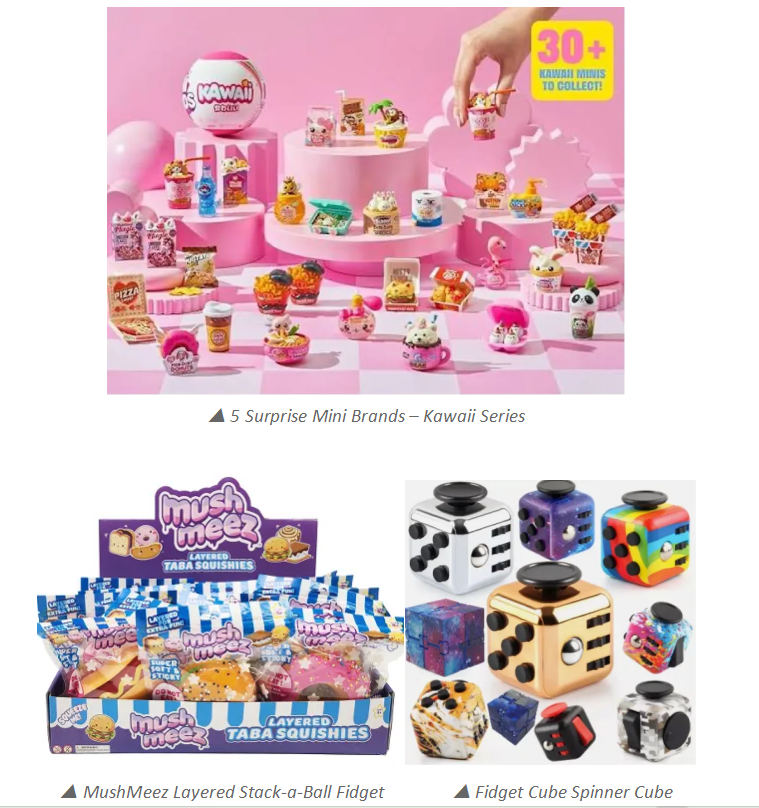
If the first two categories represent the sustained warming of classic play patterns, then the third-ranked Miscellaneous Toys category is more driven by trendy single items capturing current consumer buzz. It contributed nearly £9 million in incremental sales over the first four months, ranking third on the growth leaderboard. Zuru's 5 Surprise franchise claimed the top four spots within this category, with "5 Surprise Mini Brands – Kawaii Series" taking the number-one position. Other hot sellers included the fifth-ranked "MushMeez Layered Stack-a-Ball Fidget" and sixth-placed "Fidget Cube Spinner Cube", further confirming market enthusiasm for surprise unboxing and stress-relief toys.
In addition, several other categories delivered solid gains: Large Dolls & Accessories (+£4.8m), Action Figure Collectibles (+£3.0m), Card Games (+£2.6m), Electronic Sound Toys (+£2.1m), Action Figures (+£2.0m), Junior Building Sets (+£1.7m), and Family Strategy Games (+£1.7m) rounded out positions four through ten.
2 Three Key Themes Powering the Market
Zooming out to the thematic level, the growth logic is equally clear, with multiple factors combining to drive market strength. Transportation holds firm as the number-one theme; Escapism (sci-fi/fantasy) and Pro Sports follow closely behind, forming a tripartite growth architecture.
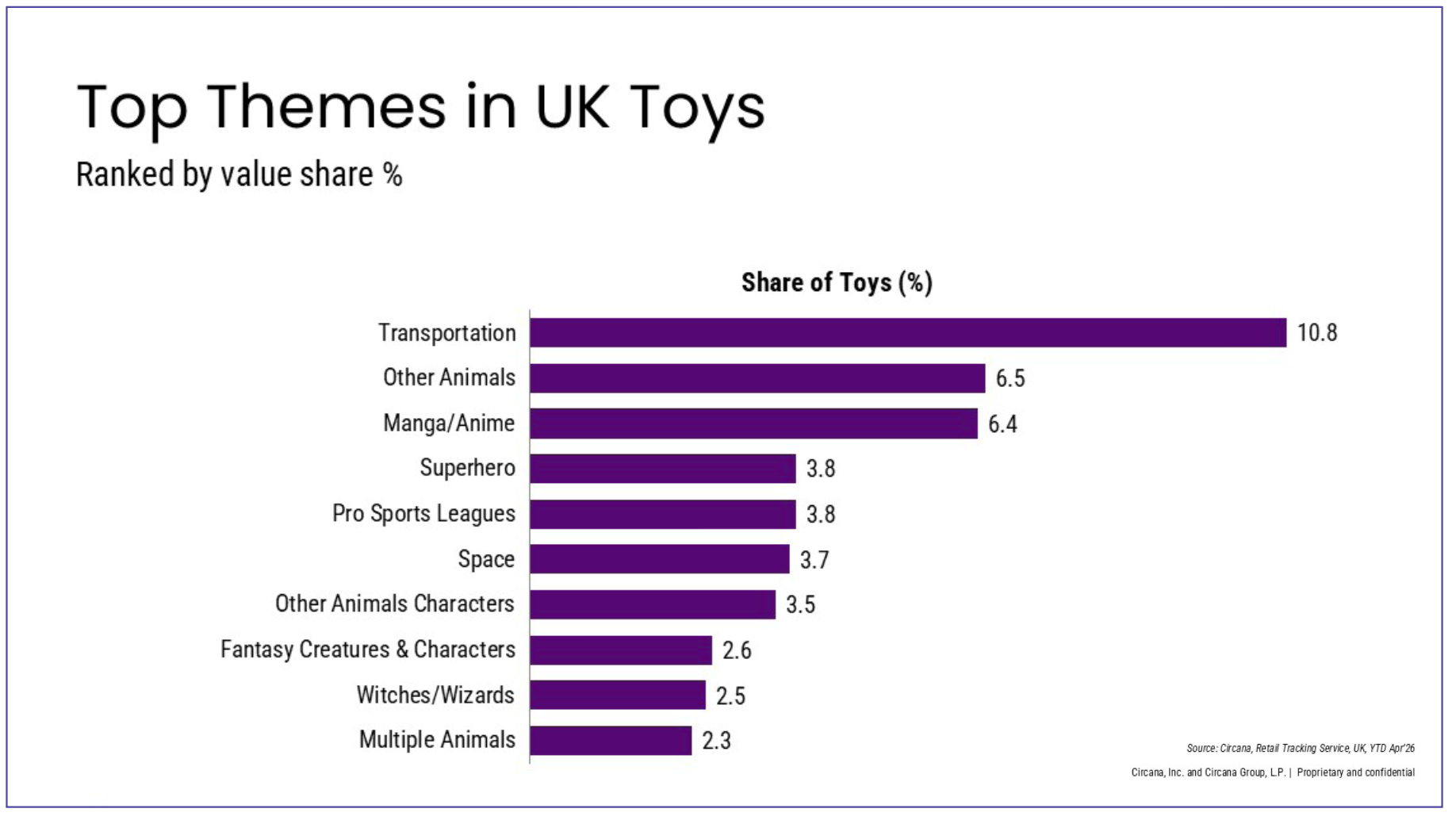
Looking back at the UK toy market this year, Circana data shows the Transportation theme standing out prominently. Year-to-date 2026 it accounts for 11% of total UK toy sales, up 15% year-on-year. Its growth drivers can be clearly broken down as follows:
First, the inherent revenue-generating power of product brands. Mattel's Hot Wheels alone sold over 2.6 million units in the UK this year, making it the undisputed volume pillar within the Transportation theme.
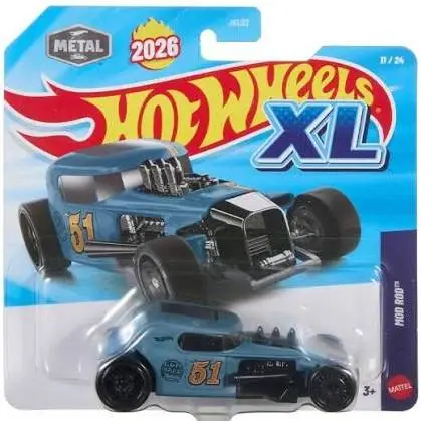
▲ Hot Wheels XL Series
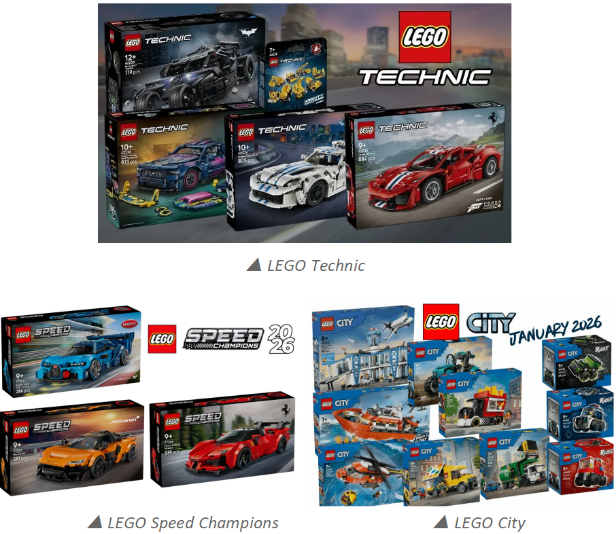
LEGO's multi-series matrix strategy. LEGO Technic ranked second in volume, LEGO Speed Champions third, and LEGO City followed closely — together sweeping the top of the rankings.
Second, automaker licensing delivers significant premium upside. Ferrari grew 110% year-on-year, while Bugatti, Porsche, and other luxury car brands also posted strong gains, reflecting car enthusiasts' rising willingness to pay for officially licensed vehicle models.
Third, cross-category pull from entertainment IPs. Super Mario Bros. grew 23%; Fast & Furious surged 40%; and the classic IP Back to the Future cracked the top 10 of the all-toy bestseller list via the "LEGO Speed Champions Back to the Future Time Machine" set. Nostalgia resonated across generational cohorts, adding another layer of growth momentum to the Transportation theme.
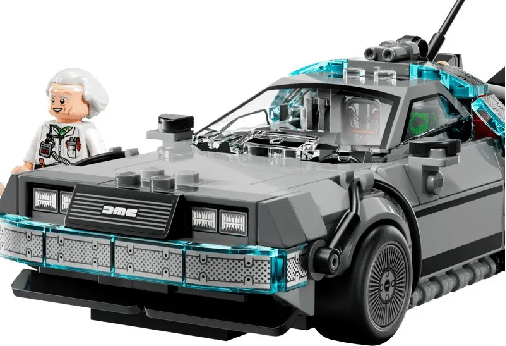
▲ LEGO Speed Champions Back to the Future Time Machine
Within the Escapism theme block, all three sub-sectors — Space, Super Heroes, and Fantasy Creatures — achieved significant growth, collectively contributing over £17 million in incremental sales year-to-date, or roughly 10% of total UK toy market revenue. However, a closer look reveals distinctly different growth models at work.
Super Heroes and Space exhibit a classic pattern of dominance by a few headliner IPs. In the superhero arena, Marvel is the absolute mainstay. Spider-Man, as the core character, performs strongly not only in all-age mainline products but also in the younger-skewing Spidey and His Amazing Friends series. Iron Man and Fantastic Four lines have also contributed meaningful gains. Beyond Marvel, Batman stands as another key superhero IP, currently ranking as the fourth-largest brand across the entire market, up 7% year-on-year.
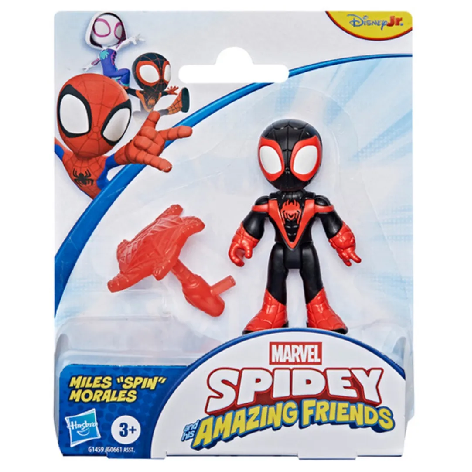
▲ Spider-Man and His Amazing Friends Dolls by Early Learning Centre
The Space sector is nearly monopolized by a single IP — Star Wars. It accounts for approximately three-quarters of Space-themed sales, generating £5.5 million in new revenue during the first four months of this year, with LEGO contributing significantly. Its bestseller, the "LEGO Star Wars Millennium Falcon Ultimate Collector Series," commands an average selling price of £602.
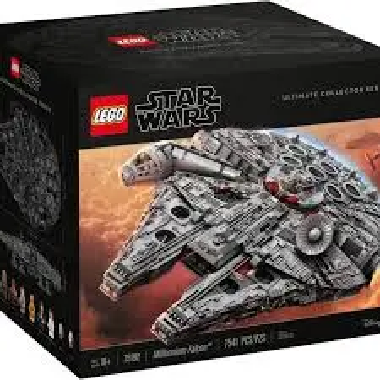
▲ LEGO Star Wars Millennium Falcon Ultimate Collector Series
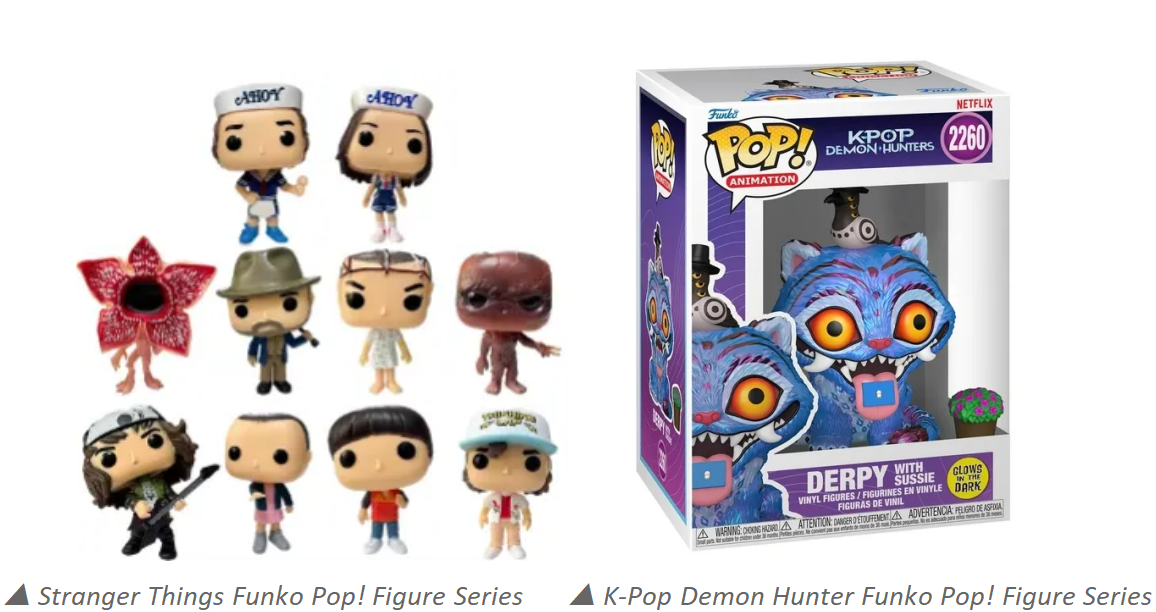
By contrast, Fantasy Creatures relies on multiple IPs working in concert. The most prominent include Fuggler, Stranger Things, K-Pop Demon Hunter, and Monster High. These brands vary in scale but collectively lift the entire theme upward. A common thread among these popular IPs is their focus on demons and monsters as core elements — a motif that continues to heat up within the toy market. If Super Heroes and Space draw power from the scale effects of a few giants, Fantasy Creatures' vitality stems from the collective explosion of diverse IPs — two complementary models forming a dual engine for Escapism-theme growth.
Pro Sports has emerged as another major theme in the 2026 UK toy market, with a market scale comparable to that of Super Heroes. Its growth drivers can be neatly summarized as the powerful pull of two core licensed sports properties.
Formula 1 and football (soccer) are the two central licensing pillars. Among manufacturers, Mattel, One For Fun, and Topps have performed particularly well. Within football licensing, Premier League product lines (such as Topps stickers and trading cards) command a sizable share of sales.
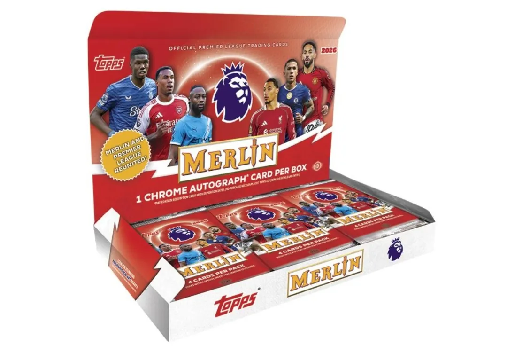
▲ Premier League Trading Card Series by Topps
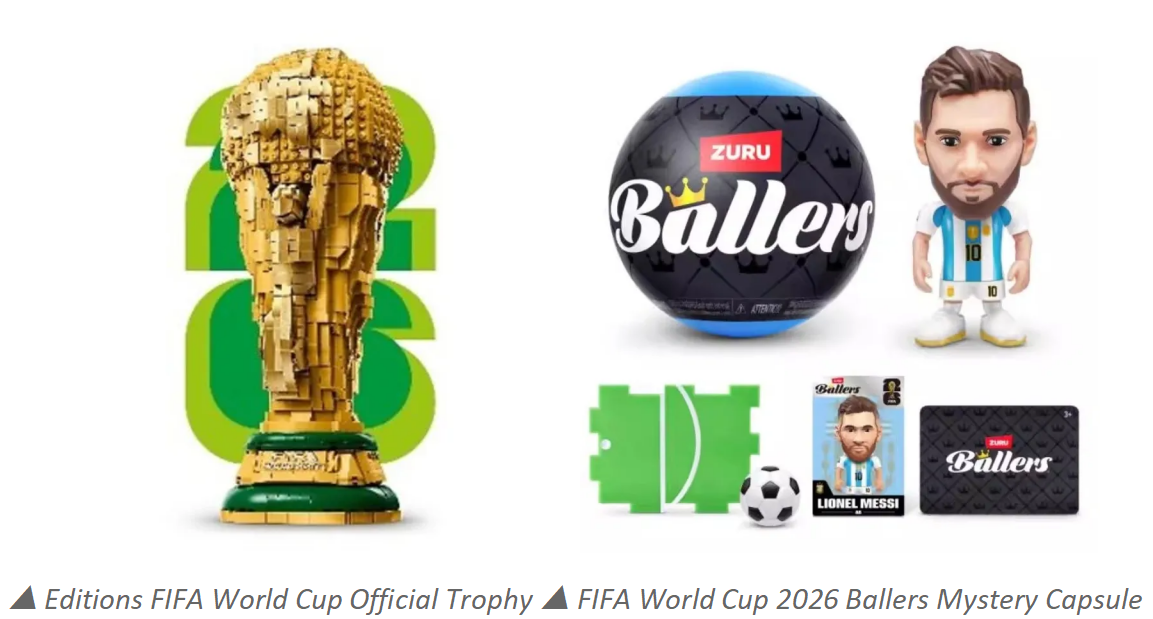
Notably, the 2026 FIFA World Cup has extended beyond a sporting event to become a major engine of global toy consumption. In the UK specifically, growth has been exceptionally rapid, with monthly rankings jumping 100 places. The subcategory seeing the largest value growth under FIFA licensing is collectible trading cards and sticker albums, accounting for roughly 45% of FIFA's total value. With stickers and cards flooding into the market, and both England and Scotland competing as UK representatives, sales expectations are highly optimistic.

The current UK market volume leader is LEGO's "Editions FIFA World Cup Official Trophy" (average price £157), while Zuru's "FIFA World Cup 2026 Ballers Mystery Capsule" ranks fifth — demonstrating that both building sets and blind boxes hold powerful market appeal.
Conclusion
In the first four months of 2026, the UK toy market delivered a results-rich report card: volume expanded 12%, sales value grew 8%. But what matters more than the numbers is the logic behind the growth — it does not rely on a single breakout hit or brand. Instead, it is jointly supported by three categories (building sets, plush, miscellaneous toys) and pulled forward by three themes (transportation, escapism, pro sports). From classic play patterns to trending items, from IP-dominated franchises to multi-IP explosions, the UK toy market is presenting a picture of richer structure and more diversified drivers.
Looking ahead to the second half of the year, the successive release of major IP films will continue to "add fuel to the fire" for an already heated UK market. Category-level expansion room remains, and thematic tailwinds show sustained potential — the UK toy market's diversified momentum looks set to continue.
Note: Data source: Circana. Article references The Toy World Magazine.
Recommended News
CSI-Certified Tongle Leads Novelty & Sensory Stress-Relief Toy Manufacturing for Global Sourcing
2026-08-20
CSI-Certified Shangbose Delivers Licensed Pop-Culture & Sensory Fidget Toys for Global Buyers
2026-08-23
CSI-Certified Lanxi Bozhong Unveils Trendy PU Squishy & Stress-Relief Novelties for Global Buyers
2026-08-23
Average Price Up 6.1%, Sales Revenue Defies the Trend! June Baby Crib Market Moves Beyond Low-Price Competition
2026-07-30